
IVF Explained: Your Complete Guide to the Science Behind Making Babies in the Lab
Say the letters “IVF” and most people picture a single dramatic moment — a sperm meeting an egg under a microscope, a scientist looking pleased. In reality, in-vitro fertilisation is a sequence: a few weeks of injections, a short procedure to collect eggs, several days of quiet work in an embryology lab, a two-minute embryo transfer, and then the longest fortnight of your life. None of it is magic, and none of it is a guarantee — but once someone walks you through what actually happens at each step, it stops being a black box and starts being a plan.
This is that walkthrough: how IVF works, start to finish, in plain English, with the science kept honest and the clinic-brochure optimism left at the door. Wherever the evidence is strong I’ll say so; wherever it’s thin — and in IVF, plenty of it is — I’ll say that too.
Quick take · screenshot this
One IVF cycle, in a single breath
- Stimulate — ~8–14 days of injections to grow several eggs
- Collect — a ~30-minute procedure under sedation
- Fertilise — egg meets sperm in the lab (IVF or ICSI)
- Grow & grade — embryos cultured for up to 5–6 days
- Transfer — one embryo placed in the womb, then the two-week wait
Everything below is simply this, slowed down and explained.
What is IVF, really? (And a quick nod to history)
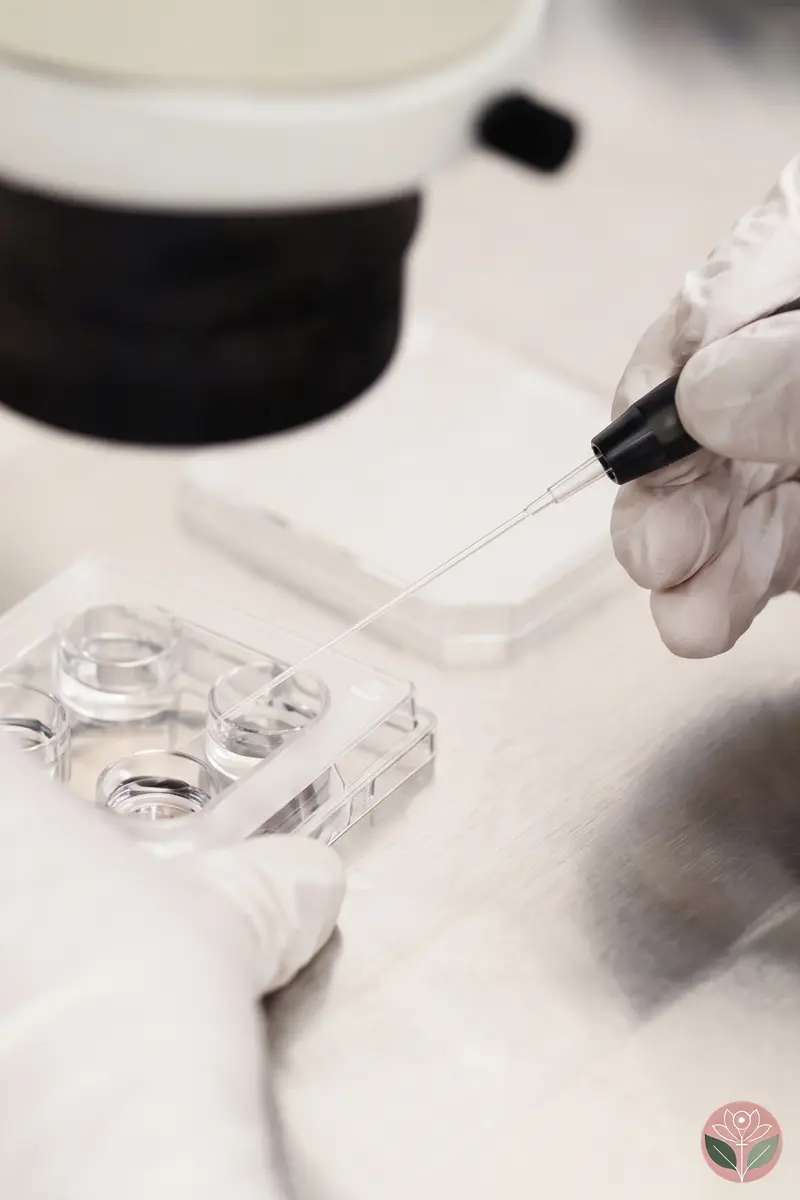
IVF means bringing egg and sperm together outside the body — in vitro is Latin for “in glass” (though we use plastic dishes nowadays, which admittedly sounds less romantic) — and then placing the resulting embryo into the womb. That’s the whole idea. Everything else is refinement.
It isn’t as new as it feels. The world’s first IVF baby, Louise Brown, was born in Oldham in July 1978, and the physiologist behind it, Robert Edwards, was awarded the Nobel Prize in 2010. What was once front-page science is now genuinely mainstream: in the UK, around 20,700 babies were born through IVF in 2023 — roughly 1 in every 32 births, up from about 1 in 80 at the turn of the millennium (HFEA, 2025). Worldwide, more than 13 million people have now been born with the help of assisted reproduction (Chambers et al., 2025).
So if you’re considering it, you’re in very large company — and the process has had four decades of refinement behind it.
Is IVF for you? Who it actually helps
IVF started life as a workaround for blocked fallopian tubes, but its reach is now much wider. It’s commonly used for infertility caused by:
- Tubal factor — damaged or blocked tubes (the original indication)
- Male factor — low count, motility or morphology (often with ICSI, below)
- Ovulation disorders — such as PCOS not responding to first-line treatment
- Endometriosis and diminished ovarian reserve
- Unexplained infertility — when everything looks normal but nothing is happening
- Same-sex couples and single people building a family with donor sperm or eggs
In the UK, NICE guidance (NG257) suggests considering IVF after around two years of regular, well-timed unprotected sex without conception — or sooner where there’s a known cause, such as blocked tubes. Where women are under 40 and meet the criteria, NICE recommends offering three full cycles on the NHS (a “full cycle” meaning one egg collection plus the transfer of every embryo it produces, fresh and frozen). The reality, sadly, is that local funding often falls short of what NICE recommends — so it’s worth checking your area’s criteria early. And before you get anywhere near a stimulation injection, the groundwork is a proper diagnosis: here’s when to start fertility testing and what your first workup involves. If you’re still weighing up your options, it helps to understand how IVF compares to IUI and ICSI before committing to the most intensive route.
How IVF works: the whole journey at a glance
Five steps and a wait. Stick this on the fridge.
Step 1 — Ovarian stimulation: growing a cohort of eggs
In a natural cycle your ovaries mature a single egg. IVF politely overrides that: for roughly 8–14 days you inject daily gonadotrophins (the hormones FSH and, sometimes, LH) to encourage several follicles to grow at once. Alongside them, a second medication — a GnRH antagonist or agonist — stops your body releasing the eggs early, before the team is ready to collect them. This is exactly the first half of an egg-freezing cycle, if you’ve read about that.
You’ll be monitored closely with transvaginal ultrasound scans (and sometimes blood tests) to track how your follicles are growing, so the dose can be tuned to you. When enough follicles reach the right size, you take a “trigger” injection — traditionally hCG — that sets off the final maturation of the eggs. Collection is booked for about 36 hours later: precise timing is everything here.
A word about OHSS (and why modern IVF is safer)
The main risk of stimulation is ovarian hyperstimulation syndrome (OHSS) — an over-response where the ovaries become swollen and fluid shifts in the body. Most cases are mild, but severe OHSS is the complication we work hardest to avoid. The good news is that modern protocols have made it far less common: a large Cochrane review found the antagonist protocol cut the risk of OHSS by around 40% compared with the older long-agonist approach, with no meaningful difference in the chance of a baby (Al-Inany et al., 2016). Add a GnRH-agonist trigger and a “freeze-all” strategy (more on that below) and late OHSS can be almost eliminated in high-risk patients (ESHRE, 2020).
Stimulation · what to expect
The fortnight of injections
- Daily injections at home (they’re smaller than they look)
- Several monitoring scans to track follicle growth
- A precisely timed “trigger” shot ~36 hours before collection
- Bloating and moodiness are common — and normal
- Tell your clinic promptly about severe pain or breathlessness
Step 2 — Egg collection: the retrieval
Egg collection (or “oocyte retrieval”) is a short procedure, usually under sedation or a light general anaesthetic, taking around half an hour. Guided by ultrasound, a fine needle passes through the vaginal wall into each follicle and gently aspirates the fluid — and, with it, the egg. You go home the same day; a bit of cramping and spotting for a day or two is completely normal.
How many eggs? It varies enormously with age and ovarian reserve, and — contrary to instinct — more is not always better. Analysis of 400,135 cycles found live-birth rates rose with the number of eggs collected up to about 15, then plateaued and eventually declined (Sunkara et al., 2011). It’s a population average, not a personal target, but it’s a useful reminder that IVF is about quality and balance, not a numbers arms race.
Serious complications are rare: in a series of over 7,000 retrievals, severe complications occurred in fewer than 0.1% (Aragona et al., 2011). The recognised risks — a little bleeding, a small infection risk, and the usual anaesthetic considerations — are real but uncommon. For the step-by-step detail of this day, see our dedicated guide to IVF egg collection. Then the baton passes to the embryologists.
Step 3 — Into the lab: fertilisation (IVF vs ICSI)
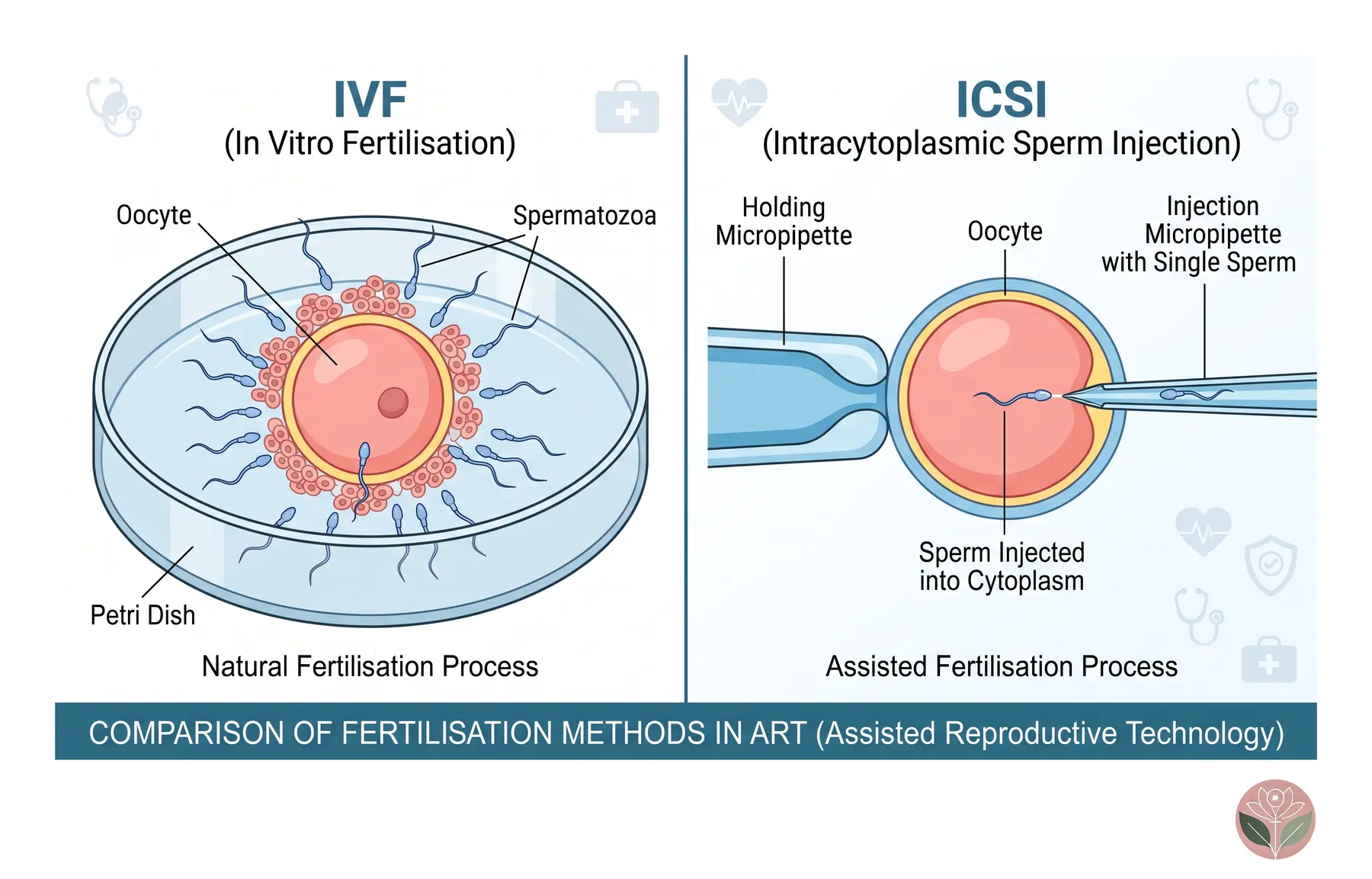
So when do you actually need ICSI? The honest answer is: less often than it’s used. ICSI was designed for — and genuinely helps with — significant male-factor infertility or a previous failure to fertilise. (If sperm quality is the issue in your case, it’s worth knowing which male fertility supplements actually have evidence behind them — most don’t.) But for couples without a sperm problem, it doesn’t improve your chances. A large randomised trial found live-birth rates of 35% with ICSI versus 31% with conventional IVF in couples with normal sperm — a difference that wasn’t statistically significant (Dang et al., 2021). The professional bodies agree there’s no good evidence ICSI helps in non-male-factor cases (ASRM/SART, 2020) — despite it being used in the majority of cycles worldwide. If sperm DNA quality is the concern, that’s a different conversation — we cover ICSI, sperm DNA fragmentation and Zymot in detail here.
Clinical note: ICSI isn’t an “upgrade.”
It’s easy to assume the fancier, more expensive technique must be better. For most couples without a male-factor diagnosis, it simply isn’t — you’d perform dozens of unnecessary injections to prevent a single unexpected fertilisation failure. Ask specifically why ICSI is being recommended for you, rather than accepting it as a default.
Step 4 — Embryo culture and grading: the quiet days
Once fertilised, your embryos are cultured in carefully controlled incubators for up to five or six days, until they reach the blastocyst stage — a more developed embryo with two distinct cell types (one that becomes the baby, one that becomes the placenta). Growing embryos to day 5–6 rather than transferring earlier (at day 2–3) helps the team choose the strongest one: a Cochrane review found blastocyst transfer probably gives a modestly higher live-birth rate per fresh cycle, though the certainty of the evidence is only low, and the advantage largely reflects better selection rather than more babies overall (Glujovsky et al., 2022).
Here’s the part clinics don’t always emphasise: not every egg becomes a blastocyst. There’s natural attrition at each stage — many eggs fertilise, fewer make good embryos, and only some reach day 5. Roughly a third to a half of day-3 embryos go on to become blastocysts, though this varies with age and egg quality. It can be disheartening to watch the numbers fall, but it’s the lab doing exactly its job: letting the embryos with the best developmental potential reveal themselves.
What does “grade” mean?
Embryologists grade blastocysts on their appearance — how expanded the embryo is, plus the quality of its two cell types, using a letter-and-number system (the Gardner grade, e.g. “4AB”). Grading helps decide which embryo to transfer first, and it does track with success: better-graded blastocysts implant more often (Gardner et al., 2000). But — and this matters — grade is a probability, not a promise. A top-grade embryo can fail to implant, and a “lesser” embryo can become your child. Grading tilts the odds; it doesn’t set them in stone.
Step 5 — Embryo transfer: one embryo, or two?
The transfer itself is almost anticlimactic — and that’s a good thing. A soft catheter passes the embryo through the cervix into the womb, usually under ultrasound guidance, with no anaesthetic needed. It takes a few minutes, and most people say it feels like a smear test. For what is worth doing in the weeks before and on the day itself, see our guide on how to prepare for your embryo transfer.
The big decision is how many to transfer. Putting back two embryos does modestly raise the chance of pregnancy in that single attempt — but it sharply raises the chance of twins, which carries real risks for mother and babies. That’s why UK practice favours elective single embryo transfer (eSET): transfer one, freeze the rest, and if the first doesn’t work, transfer another in a later cycle. Across a full course of treatment, this gives a similar cumulative chance of a baby as double transfer, with far fewer multiple pregnancies (McLernon et al., 2010). One healthy baby at a time is the goal.
Fresh or frozen? The “freeze-all” question
Embryos can be transferred fresh (a few days after collection) or frozen and transferred in a later month. Freezing technology (vitrification) is now so good that frozen embryos survive thawing extremely well, and “freeze-all” cycles — where everything is frozen and nothing transferred fresh — have become common. Is frozen better? Not universally. A Cochrane review found little or no difference in cumulative live birth between fresh and frozen strategies, but much less OHSS with freeze-all (Zaat et al., 2021). Two large trials tell a nuanced story: in ovulatory women, freezing didn’t beat fresh for live birth but caused less OHSS (Shi et al., 2018), while in good-prognosis women having a single blastocyst, frozen transfer did give higher live birth — but also more pre-eclampsia (Wei et al., 2019). The upshot: freeze-all is a genuinely good option for high responders and those at OHSS risk, not an automatic win for everyone.
The two-week wait: the hardest part no one warns you about

After transfer you’ll usually take progesterone (as pessaries, gel or injections) to support the womb lining — this “luteal support” genuinely improves the odds, as the drugs used in IVF disrupt your body’s own progesterone production (van der Linden et al., 2015). Then comes the wait for a blood test (beta-hCG), usually around 9–14 days after transfer.
Two weeks of waiting is, for most people, the hardest part of the whole cycle — and if the anxiety is getting loud, our guide to stress and fertility covers what genuinely helps (and what’s just noise). Please resist the urge to test at home on day three. Too early and you’ll get a false negative; test too soon after the trigger shot and its leftover hCG can give a false positive. The clinic’s blood test — often repeated 48 hours later to check the level is rising — is the one that actually tells you the truth.
Surviving the fortnight
A few things that genuinely help
- Take your progesterone exactly as prescribed — it matters
- Carry on normal, gentle life; bed rest doesn’t improve success
- Step back from Dr Google and home tests
- Line up a distraction, and someone to talk to
- Whatever the result, your feelings about it are valid
IVF success rates by age: the numbers no one puts on a brochure
This is the question everyone really wants answered, and the honest version has caveats — so let’s be careful with it. The single most important fact is that IVF success falls with age, because it tracks the age of the eggs. Here’s the UK picture, measured as the chance of a live birth per embryo transferred using a woman’s own eggs (HFEA data):
Three things to hold in mind when you read any success rate:
- Which number is it? “Per embryo transferred” (above) looks higher than “per cycle started,” because some cycles are cancelled along the way. Clinics don’t always make clear which they’re quoting — so ask.
- Averages hide individuals. These are national figures across everyone; your own odds depend on your diagnosis, egg quality and history. The most recent HFEA data actually show birth rates have improved over time, averaging around 30% per embryo transferred.
- Cumulative beats per-cycle. Your chance of a baby across several attempts is much higher than any single go (see below).
For a fuller breakdown, including how IVF stacks up at 40+, see the age-by-age figures in our guide to realistic IVF success rates by age.
The add-ons question: which extras are actually worth paying for?
Somewhere around the treatment-planning stage, you’ll be offered “add-ons” — optional extras, often at extra cost, promising to boost your chances. Some sound wonderfully high-tech. Here’s the uncomfortable truth: for most patients, most add-ons don’t have good evidence that they increase your chance of a baby.
The UK regulator, the HFEA, rates add-ons using a colour-coded system — and, tellingly, no add-on is currently rated green (green means high-quality evidence of a benefit for most people). Here’s where some of the best-known ones sit:
A couple of the headline studies make the point. PGT-A (screening embryos for chromosome numbers) sounds compelling, but the STAR randomised trial found it did not improve ongoing pregnancy rates for a general good-prognosis group (Munné et al., 2019) — which is why the HFEA now flags it as potentially reducing your chance of a baby for most patients. The endometrial scratch, once widely offered, was put to the test in a large trial of over 1,300 women and made no difference to live birth (Lensen et al., 2019). None of this means add-ons are never appropriate — some have a role in specific situations — but they should be a considered, individual decision, not an upsell.
Before you pay extra, ask three questions:
(1) What does the evidence say this does for someone like me? (2) What’s the HFEA rating? (3) What does it cost, and what happens if I skip it? A good clinic will welcome these questions — not bristle at them.
Starting IVF and not sure what applies to you?
A video consultation with Dr Helena Cepparo goes through your history and results and works out what’s worth doing in your case, with a functional approach. If scans, tests or treatment follow, she arranges them herself in central London. One doctor, from your first question onwards.
How many rounds of IVF will I need?
It’s tempting to think of IVF as one big roll of the dice. It’s more accurate — and more hopeful — to think of it as a course of treatment. Chances accumulate with each complete cycle. A UK study of around 156,000 women found the live-birth rate was about 29% after the first cycle, rising to roughly 65% by the sixth (Smith et al., 2015). Other UK data put the cumulative chance after three complete cycles somewhere between about 42% and 57%, depending on assumptions (McLernon et al., 2016).
Two honest caveats. First, this is strongly age-dependent — the ceilings above apply best to younger women. Second, “keeping going” is easier said than done: cost, and the emotional toll, mean many people stop before they reach those higher cumulative numbers, and that’s an entirely understandable choice. But if you’re staring down a first negative result, the data are clear that one cycle is rarely the whole story.
Starting IVF and not sure what applies to you?
A video consultation with Dr Helena Cepparo goes through your history and results and works out what’s worth doing in your case, with a functional approach. If scans, tests or treatment follow, she arranges them herself in central London. One doctor, from your first question onwards.
The bottom line
IVF isn’t magic and it isn’t a guarantee — but it also isn’t the impenetrable mystery it can feel like from the outside. It’s a logical sequence: grow eggs, collect them, fertilise them, grow and choose the best embryo, transfer it, and wait. Understanding how IVF works won’t change your biology, but it will help you ask sharper questions, spot an unnecessary upsell, and make decisions that fit you.
And if you’re preparing for a cycle, the weeks beforehand aren’t wasted time — there’s plenty you can genuinely influence. Our companion guide walks you through how to prepare for IVF naturally in the 90 days before you start — and if you only change one thing, make it your sleep, which has more to do with reproductive hormones than most people expect.
Questions patients ask me every week
+
The real questions from clinic — answered directly, without the vagueness.
What is IVF, and how does IVF work?+
IVF (in-vitro fertilisation) means fertilising an egg with sperm outside the body, in a laboratory, and then placing the resulting embryo into the womb. A full cycle involves stimulating the ovaries to grow several eggs, collecting them in a short procedure, fertilising them in the lab (by conventional IVF or ICSI), growing the embryos for a few days, and transferring one — followed by a two-week wait before a pregnancy test.
How long does one IVF cycle take?+
From the first stimulation injection to the pregnancy test, a single fresh cycle usually spans about four to six weeks. Ovarian stimulation is roughly 8–14 days, egg collection happens around 36 hours after the trigger injection, embryos are grown for up to five or six days, and then there’s the two-week wait after transfer. Frozen-embryo transfers happen in a separate later month.
What are the success rates of IVF by age?+
Success falls with age because it follows the age of the eggs. Using UK HFEA figures for live birth per embryo transferred with your own eggs, the rate is roughly 33% under 35, about 25% at 35–37, around 17% at 38–39, about 10% at 40–42 and around 4% at 43–44. These are national averages that shift year to year; donor eggs depend far less on the recipient’s age, and your cumulative chance across several cycles is considerably higher than any single attempt.
Is ICSI better than regular IVF?+
Not for most couples. ICSI — injecting a single sperm into each egg — clearly helps when there’s significant male-factor infertility or a previous fertilisation failure. But for couples without a sperm problem, a randomised trial found no significant difference in live birth between ICSI and conventional IVF (35% vs 31%). It isn’t an “upgrade,” so ask specifically why it’s being recommended for you.
Should I have one embryo or two transferred?+
For most people, one. Transferring two slightly raises the chance of pregnancy in that attempt but sharply increases the risk of twins, which is riskier for mother and babies. Elective single embryo transfer, with any remaining embryos frozen for later, gives a similar cumulative chance of a baby across a full course of treatment with far fewer multiple pregnancies.
Are IVF add-ons like time-lapse imaging and PGT-A worth paying for?+
Usually not, for most patients. The HFEA rates IVF add-ons on an evidence scale, and none is currently rated green (proven benefit for most people). Time-lapse imaging shows no clear benefit, PGT-A did not improve outcomes for a general good-prognosis group in a randomised trial and may reduce chances for some, and the endometrial scratch made no difference to live birth in a large study. Some add-ons have a role in specific situations, but they should be an individual, evidence-based decision — not a routine upsell.
Does egg collection hurt?+
It’s done under sedation or a light general anaesthetic, so you won’t feel it at the time, and it takes around half an hour. Afterwards, mild cramping and light spotting for a day or two are common. Serious complications are rare, occurring in well under 1% of procedures.
How many rounds of IVF will I need?+
There’s no fixed answer, but IVF is best thought of as a course rather than a single attempt. UK data show the live-birth rate rises from about 29% after one cycle to roughly 65% by the sixth in younger women. It’s strongly age-dependent, and many people stop earlier for cost or emotional reasons — but a first negative result is rarely the end of the story.
References & Scientific Sources
+
21 sources, with links to the original papers.
- Human Fertilisation and Embryology Authority. Fertility treatment 2023: trends and figures. 2025. HFEA report
- Chambers GM, et al. How many infants have been born with the help of assisted reproductive technology? Fertility and Sterility. 2025. doi:10.1016/j.fertnstert.2025.02.009
- National Institute for Health and Care Excellence. Fertility problems: assessment and treatment. NICE guideline NG257. 2024. nice.org.uk/guidance/ng257
- Al-Inany HG, Youssef MA, Ayeleke RO, Brown J, Lam WS, Broekmans FJ. Gonadotrophin-releasing hormone antagonists for assisted reproductive technology. Cochrane Database of Systematic Reviews. 2016;4(4):CD001750. doi:10.1002/14651858.CD001750.pub4
- ESHRE Guideline Group on Ovarian Stimulation. ESHRE guideline: ovarian stimulation for IVF/ICSI. Human Reproduction Open. 2020;2020(2):hoaa009. doi:10.1093/hropen/hoaa009
- Sunkara SK, Rittenberg V, Raine-Fenning N, Bhattacharya S, Zamora J, Coomarasamy A. Association between the number of eggs and live birth in IVF treatment: an analysis of 400,135 treatment cycles. Human Reproduction. 2011;26(7):1768–1774. doi:10.1093/humrep/der106
- Aragona C, Mohamed MA, Espinola MSB, et al. Clinical complications after transvaginal oocyte retrieval in 7,098 IVF cycles. Fertility and Sterility. 2011;95(1):293–294. doi:10.1016/j.fertnstert.2010.07.1054
- Dang VQ, Vuong LN, Luu TM, et al. ICSI versus conventional IVF in couples with infertility in whom the male partner has normal total sperm count and motility: an open-label, randomised controlled trial. The Lancet. 2021;397(10284):1554–1563. doi:10.1016/S0140-6736(21)00535-3
- Practice Committees of the ASRM and SART. Intracytoplasmic sperm injection (ICSI) for non–male factor indications: a committee opinion. Fertility and Sterility. 2020;114(2):239–245. doi:10.1016/j.fertnstert.2020.05.032
- Glujovsky D, Quinteiro Retamar AM, Alvarez Sedó CR, Ciapponi A, Cornelisse S, Blake D. Cleavage-stage versus blastocyst-stage embryo transfer in assisted reproductive technology. Cochrane Database of Systematic Reviews. 2022;5(5):CD002118. doi:10.1002/14651858.CD002118.pub6
- Gardner DK, Lane M, Stevens J, Schlenker T, Schoolcraft WB. Blastocyst score affects implantation and pregnancy outcome: towards a single blastocyst transfer. Fertility and Sterility. 2000;73(6):1155–1158. doi:10.1016/S0015-0282(00)00518-5
- McLernon DJ, Harrild K, Bergh C, et al. Clinical effectiveness of elective single versus double embryo transfer: meta-analysis of individual patient data from randomised trials. BMJ. 2010;341:c6945. doi:10.1136/bmj.c6945
- Zaat T, Zagers M, Mol F, Goddijn M, van Wely M, Mastenbroek S. Fresh versus frozen embryo transfers in assisted reproduction. Cochrane Database of Systematic Reviews. 2021;2(2):CD011184. doi:10.1002/14651858.CD011184.pub3
- Shi Y, Sun Y, Hao C, et al. Transfer of fresh versus frozen embryos in ovulatory women. New England Journal of Medicine. 2018;378(2):126–136. doi:10.1056/NEJMoa1705334
- Wei D, Liu J-Y, Sun Y, et al. Frozen versus fresh single blastocyst transfer in ovulatory women: a multicentre, randomised controlled trial. The Lancet. 2019;393(10178):1310–1318. doi:10.1016/S0140-6736(18)32843-5
- van der Linden M, Buckingham K, Farquhar C, Kremer JAM, Metwally M. Luteal phase support for assisted reproduction cycles. Cochrane Database of Systematic Reviews. 2015;(7):CD009154. doi:10.1002/14651858.CD009154.pub3
- Human Fertilisation and Embryology Authority. Treatment add-ons with limited evidence. Accessed 2026. hfea.gov.uk/treatments/treatment-add-ons
- Munné S, Kaplan B, Frattarelli JL, et al; STAR Study Group. Preimplantation genetic testing for aneuploidy versus morphology as selection criteria for single frozen-thawed embryo transfer in good-prognosis patients: a multicenter randomized clinical trial. Fertility and Sterility. 2019;112(6):1071–1079.e7. doi:10.1016/j.fertnstert.2019.07.1346
- Lensen S, Osavlyuk D, Armstrong S, et al. A randomized trial of endometrial scratching before in vitro fertilization. New England Journal of Medicine. 2019;380(4):325–334. doi:10.1056/NEJMoa1808737
- Smith ADAC, Tilling K, Nelson SM, Lawlor DA. Live-birth rate associated with repeat in vitro fertilization treatment cycles. JAMA. 2015;314(24):2654–2662. doi:10.1001/jama.2015.17296
- McLernon DJ, Maheshwari A, Lee AJ, Bhattacharya S. Cumulative live birth rates after one or more complete cycles of IVF: a population-based study of linked cycle data from 178,898 women. Human Reproduction. 2016;31(3):572–581. doi:10.1093/humrep/dev336