Why sleep matters for fertility: what the science says (and how to sleep better)

What’s really happening while you sleep
Think of sleep as your body’s overnight maintenance crew. In men, testosterone peaks during deep sleep and crashes with too little rest or fragmented sleep.
Women’s systems are equally finicky: the hormones that coordinate follicle development and ovulation follow precise daily rhythms that get scrambled by poor sleep.
Mess with your sleep architecture—whether through shift work, staying up doom-scrolling, or chronic insomnia—and you’re essentially asking your reproductive system to function without its instruction manual.
Sleep problems and getting pregnant
Multiple large studies show a pattern: people with sleep issues (poor quality, sleeping way too much or too little, irregular schedules) tend to have lower odds of conceiving each month.
It’s not a guarantee either way—some people with terrible sleep get pregnant easily, while others with perfect sleep habits struggle—but the overall trend is clear.
Night-shift workers face particular challenges. Working nights repeatedly shows up as a risk factor for irregular cycles and needing fertility treatment, likely because it throws your internal clock completely out of sync.
If you work nights and you’re trying to conceive, this is worth discussing with your doctor.
IVF and sleep: the data is piling up
If you’re doing IVF or ICSI, your sleep quality might matter more than you’d think. Several recent studies paint a consistent picture:
- A 2022 study found that sleep quality (not anxiety or depression) predicted which women would get pregnant after IVF
- A 2024 study linked poor sleep quality, trouble falling asleep, sleeping ≥10 hours a night, and long daytime naps to fewer eggs retrieved, fewer mature eggs, and lower-quality embryos
- Multiple reviews from 2024-2025 confirm the pattern, though they’re all calling for bigger, better studies to nail down the cause-and-effect
The effect sizes aren’t huge, but when you’re doing IVF, every percentage point matters.
The PCOS-sleep apnea connection you need to know about
 Here’s something many women with PCOS don’t realise: about 35% of women with PCOS also have obstructive sleep apnea (OSA)—that’s 2-3 times higher than the general population. And it’s not just because of weight; even after accounting for BMI, PCOS patients have higher OSA rates.
Why does this matter for fertility? Because the combination is rough:
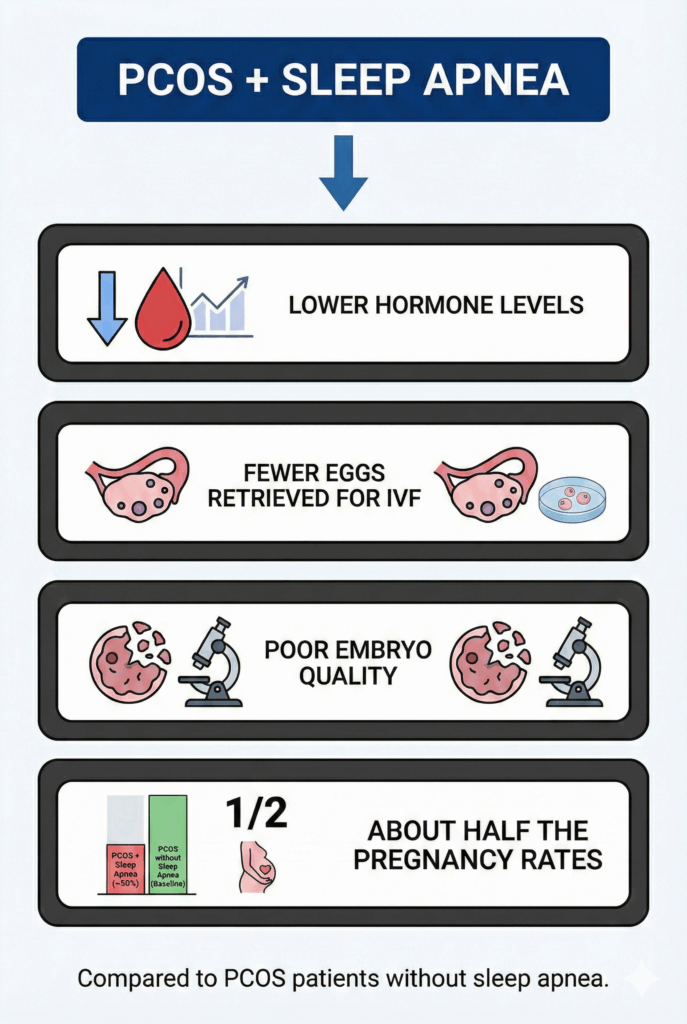
Multiple 2024 studies found that women with both PCOS and OSA undergoing IVF had:
- Lower AMH and LH levels (though AMH may still be elevated compared to women without PCOS)
- Fewer eggs retrieved during retrieval
- Poorer embryo quality
- About half the pregnancy rates compared to PCOS patients without sleep apnea
The 2023 International PCOS Guidelines now recommend that women with PCOS get screened for sleep apnea. If you snore loudly, wake up gasping, or feel exhausted no matter how long you’re in bed, talk to your doctor.
Treating sleep apnea might improve your fertility outcomes (and your quality of life in general).
For the guys: sleep and sperm
Men aren’t off the hook.
Multiple studies show that both short sleep (under 6-7 hours) and long sleep (over 8-9 hours) associate with lower sperm counts, reduced motility, and worse morphology.
The sweet spot appears to be 7-8 hours—an inverted U-pattern that suggests your testicles are as Goldilocks-y about sleep as the rest of you.
Melatonin: helpful supplement or hype?
Melatonin—the hormone that makes you sleepy—is also a powerful antioxidant that shows up in follicular fluid. Some early studies suggest that melatonin supplements might improve egg and embryo quality during IVF, possibly by reducing oxidative stress. But the evidence is mixed, and effects on actual pregnancy rates are inconsistent.
Bottom line: Don’t rely on melatonin supplements to fix fertility issues, but do prioritize
Sleeping badly while trying and not sure what applies to you?
A video consultation with Dr Helena Cepparo goes through your history and results and works out what’s worth doing in your case, with a functional approach. If scans, tests or treatment follow, she arranges them herself in central London. One doctor, from your first question onwards.
How to actually sleep better when you’re trying to conceive
Let’s get practical. Here’s what actually helps:
Stick to a schedule (yes, even on weekends)
Your reproductive hormones love predictability. Try to keep bedtime and wake time within a 30-45 minute window, even on days off. Your ovaries will thank you.
Get your light exposure right
Morning sunlight (10-30 minutes outside) and dim evenings (screens off 60-90 minutes before bed) help your body produce melatonin at the right time. Your phone’s night mode isn’t enough—the blue light still matters.
Temperature matters more than you think
Keep your bedroom around 18-19°C (65-67°F). Your body needs to cool down to fall asleep, and a hot room fights against that.
Strategic caffeine and alcohol
Cut caffeine after early afternoon. As for alcohol: even though it might make you drowsy initially, it fragments your sleep and reduces sleep quality. Not ideal when you’re trying to optimize everything.
Exercise—but time it right
Regular physical activity improves sleep, but vigorous evening workouts can wire some people. If you’re struggling to fall asleep, move your workout to morning or early afternoon.
Keep naps short and early
One IVF study found that longer daytime naps (over an hour) correlated with lower egg maturation rates. If you need to nap, keep it under 20-30 minutes and before 3 PM.
Screen for sleep disorders
This is especially important if you have PCOS. Signs to watch for:
– Loud snoring
– Gasping or pausing breathing during sleep
– Waking up exhausted despite “enough” sleep
– Severe daytime sleepiness
Sleep apnea is treatable, and treatment can improve both your metabolic health and your fertility outcomes.
For night-shift workers
If possible, keep a consistent sleep schedule even on work days. Use bright light during your shift and wear dark glasses on the drive home.
Prioritise getting your full sleep hours on off-days. Talk to your doctor if your cycles become irregular—there may be scheduling strategies that help.

The bottom line
Perfect sleep won’t guarantee pregnancy—fertility is complex and multifactorial. But better sleep gives your reproductive system the best possible environment to do its job.
Think of it as creating fertile ground: you’re not forcing anything to grow, you’re just removing obstacles.
And unlike many factors in fertility, sleep is something you have real control over. Start with one or two changes from this list, give them a few weeks, and see how you feel.
Your body—and possibly your future embryos—will appreciate the effort.
Sleeping badly while trying and not sure what applies to you?
A video consultation with Dr Helena Cepparo goes through your history and results and works out what’s worth doing in your case, with a functional approach. If scans, tests or treatment follow, she arranges them herself in central London. One doctor, from your first question onwards.