
The Mouth–Fertility Link – Why your gums might deserve a place on your Fertility TTC checklist

When people think about fertility, they picture ovaries, sperm, hormones, tubes, endometrium… not gums. Yet one of the more consistent “quiet themes” across recent research is that chronic gum inflammation (especially periodontitis) is associated with fertility challenges and reproductive outcomes.
The key word is associated—science isn’t (yet) saying “gum disease causes infertility”—but the signal is strong enough to take seriously. And honestly this is one of the rare health checks that’s practical, relatively inexpensive, and good for you regardless of fertility.
Teeth vs Gums: A Quick Clarification
Cavities are a tooth-structure problem. Gum disease is different: it’s inflammation and infection in the tissues that hold teeth in place.
The fertility conversation centres on periodontitis, the longer-term form, because it represents a chronic inflammatory state—essentially a low-grade fire that never quite goes out.
So What’s the Connection?
Periodontitis triggers your immune system to release inflammatory markers (IL-1β, IL-6, TNF-α) into the bloodstream.
Here’s the thing: these same markers play critical roles in ovulation, implantation, and early pregnancy. Fertility isn’t just “plumbing and hormones”—it’s also an immune and inflammatory event.
When baseline inflammation runs high, it can interfere with the finely tuned environment conception requires.
For men, the mechanism is similar: systemic inflammation and oxidative stress can affect sperm production and quality. The mouth-to-body connection is more direct than most people realise.
What Does the Research Say?
The SMILE Study is the strongest evidence to date. This Australian trial analysed over 3,400 pregnant women and found those with periodontal disease took two months longer to conceive on average (7.1 months vs 5 months).
The researchers described this effect as “of the same order of magnitude asobesity.” Non-Caucasian women were most affected, possibly due to higher inflammatory responses to periodontal bacteria. [1]

A 2022 systematic review examining six studies on periodontitis and conception concluded that across most studies, “the chance of conception was significantly lower in women with periodontal disease.” [2]
For men, a comprehensive 2025 systematic review in BMC Oral Health found significant associations between periodontitis and decreased sperm motility, abnormal morphology, and increased DNA fragmentation. [3]
Earlier research found that 88% of men attending IVF clinics had gingivitis or periodontitis, with 63% showing abnormal sperm counts. [4] The authors suggest that “maintaining optimal oral health may play a crucial role in improving sperm quality, particularly for men with infertility concerns.”
The PCOS and Endometriosis Connection
Researchers have found intriguing links between periodontal disease and conditions that frequently cause fertility challenges.
Endometriosis: Data from a large US survey (NHANES) found women with endometriosis had 57% higher odds of having periodontal disease. [5]
A 2024 study using genetic data (Mendelian randomisation) even suggested a causal relationship—oral bacteria like P. gingivalis may reach the pelvic peritoneum via the bloodstream and contribute to inflammatory cascades. [6]
PCOS: Both PCOS and periodontitis involve chronic low-grade inflammation, oxidative stress, and insulin resistance.
Studies show women with PCOS have higher rates of periodontal disease, and the two conditions may aggravate each other through shared inflammatory pathways. [7]
“But My Gums Only Bleed a Little…”
Bleeding gums are not a personality trait. They’re usually inflammation. If you notice any of the following, it’s worth acting sooner rather than later:
- Gums that bleed when brushing or flossing
- Persistent bad breath
- Gum tenderness, swelling, or recession
- Teeth that feel slightly loose or “different” when you bite
What To Do (Simple, Realistic, Effective)
Get a proper dental check—ideally asking specifically for a periodontal assessment, not just “any cavities?” This involves measuring pocket depths around your teeth.
If periodontitis is present, professional cleaning (scaling and root planing) can significantly improve both gum health and systemic inflammation.
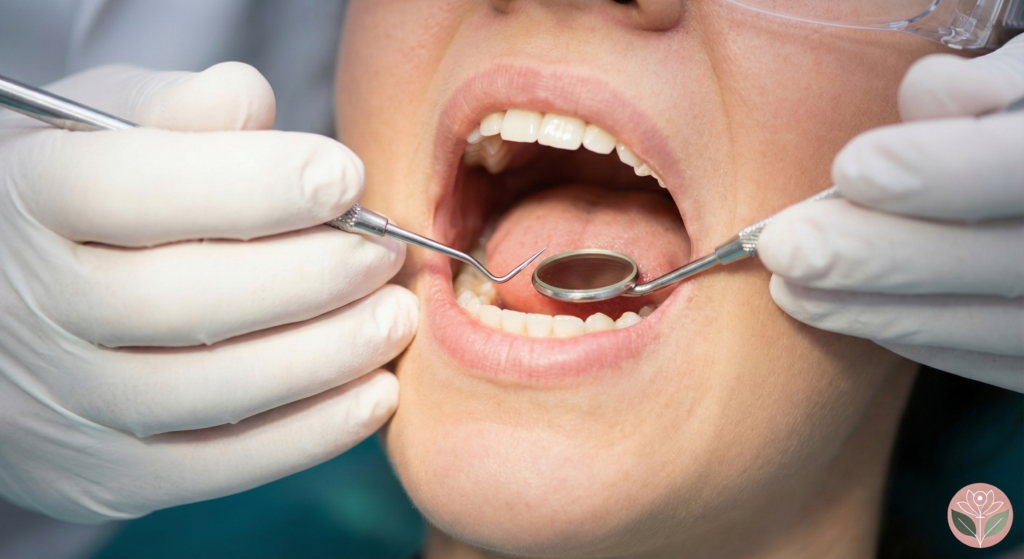
At home, it’s the unglamorous basics that win: brush twice daily with fluoride toothpaste, clean between teeth daily (floss or interdental brushes), and consider an electric toothbrush if technique is inconsistent.
If you smoke or vape, gums and fertility both do better without it—one of those double-win changes.
Preparing for IVF/IUI? It’s reasonable to treat oral health as part of your preconception optimisation—alongside thyroid, vitamin D, and lifestyle factors.
Some experts suggest completing periodontal treatment a few weeks before starting fertility treatment, as dental procedures can temporarily spike inflammatory markers.
Wondering whether your gums matter for your fertility?
A video consultation with Dr Helena Cepparo goes through your history and results and works out what’s worth doing in your case, with a functional approach. If scans, tests or treatment follow, she arranges them herself in central London. One doctor, from your first question onwards.
The Honest Bottom Line
We have associations and plausible mechanisms, but we still need larger studies to prove whether treating gum disease measurably improves natural conception or IVF outcomes.
The research is promising but not definitive.
However, treating periodontal disease is beneficial on its own—for cardiovascular health, diabetes control, and keeping your teeth. It likely reduces systemic inflammatory “noise.” If it also gives your fertility a modest boost, that’s a bonus.
If your gums bleed every time you brush, your immune system is essentially sending you daily push notifications titled: “Inflammation: still here.” When you’re trying to conceive, fewer inflammatory distractions is rarely a bad strategy.
Optimising oral health isn’t “extra”—it’s foundational.
Wondering whether your gums matter for your fertility?
A video consultation with Dr Helena Cepparo goes through your history and results and works out what’s worth doing in your case, with a functional approach. If scans, tests or treatment follow, she arranges them herself in central London. One doctor, from your first question onwards.
References
- Hart R et al. Periodontal disease: a potential modifiable risk factor limiting conception. Human Reproduction. 2012;27(5):1332-1342.
- Ricci E et al. Periodontitis, female fertility and conception (Review). Biomedical Reports. 2022;17(5):86.
- Mortazavi V et al. Exploring the link between periodontal disease and sperm quality: a systematic review. BMC Oral Health. 2025;25(1):742.
- Klinger A et al. Periodontal status of males attending an in vitro fertilization clinic. J Clin Periodontol. 2011;38(6):542-546.
- Kavoussi SK et al. Periodontal disease and endometriosis: Analysis of NHANES. Fertil Steril. 2009;91(2):335-342.
- Jin B et al. Association between periodontitis and endometriosis: a bidirectional Mendelian randomization study. Front Endocrinol. 2024;15:1271351.
- Kellesarian SV et al. Polycystic Ovary Syndrome and Periodontal disease: Underlying Links. J Int Soc Prev Community Dent. 2018;8(3):206-213.
- Ludovichetti FS et al. Can periodontal disease affect conception? A literature review. Reprod Fertil. 2021;2(1):R27-R34.